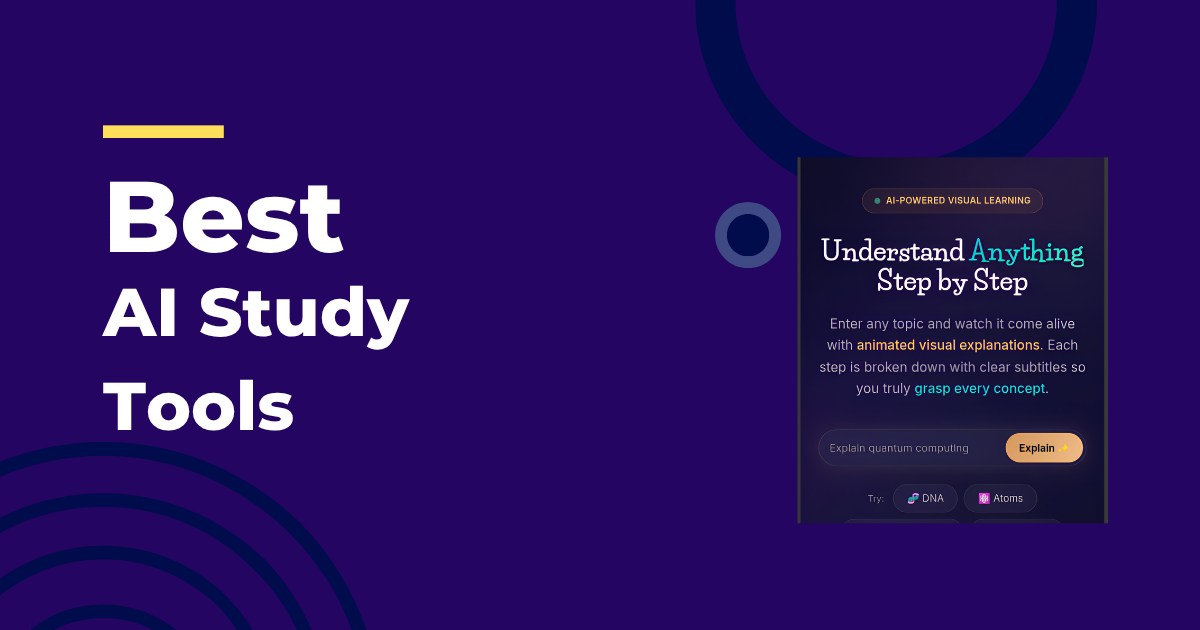
AI has transformed how students study. But with hundreds of tools claiming to "revolutionize learning," which ones actually help you understand — not just generate answers to copy?
Here's an honest breakdown of the best AI study tools in 2026, what they're good for, and where they fall short.
1. ChatGPT / Claude — Best for Explanations in Text
What it does: Answer any question, explain concepts, summarize notes, write practice problems.
What it's great at:
- Getting a quick explanation of any concept
- Generating practice problems with solutions
- Summarizing long readings into key points
Where it falls short:
- Explanations are text-only — no visuals
- Can confidently state wrong information (hallucination)
- Doesn't build deep intuition — just gives answers
Best for: Quick answers, essay help, practice problem generation
Rating for deep learning: ⭐⭐⭐/5
2. Khan Academy — Best Free Structured Curriculum
What it does: Free video lessons, practice problems, and mastery challenges across math, science, and humanities.
What it's great at:
- Structured progression from basics to advanced
- Instant feedback on practice problems
- Completely free
- Well-tested curriculum
Where it falls short:
- Can't generate explanations for your specific question
- Videos are mostly lecture-style, not highly interactive
- Limited to their pre-made content
Best for: Following a structured curriculum, SAT/ACT prep, filling foundational gaps
Rating for deep learning: ⭐⭐⭐⭐/5
3. Anki / Flashcard AI Tools — Best for Memorization
What it does: Spaced repetition flashcard systems, often enhanced by AI to auto-generate cards from your notes.
What it's great at:
- Vocabulary, dates, formulas, definitions
- Spaced repetition = extremely efficient memorization
- Works for any language
Where it falls short:
- Memorization ≠ understanding
- Won't help you understand why something is true
- Useless for conceptual understanding in math/science
Best for: Language learning, history dates, biology terms, medical school
Rating for deep learning: ⭐⭐/5
4. Wolfram Alpha — Best for Math Problem Solving
What it does: Solve math problems step-by-step, from basic algebra to differential equations and beyond.
What it's great at:
- Seeing exactly how to solve a problem
- Graphing functions
- Checking your work
Where it falls short:
- Shows steps, but doesn't build intuition
- No concept explanations — just computation
- Can enable lazy learning if used as a crutch
Best for: Checking homework, understanding calculation steps, graphing
Rating for deep learning: ⭐⭐⭐/5
5. ExplaNote — Best for Visual Understanding
What it does: Generates 3Blue1Brown-style animated visual explanations for any topic.
What it's great at:
- Building genuine intuition through animation
- Any topic, on demand — not just a pre-set curriculum
- Follow-up questions with visual answers
- Topics that need to be seen (calculus, physics, chemistry, biology)
Where it falls short:
- Takes ~3 minutes to generate (not instant)
- Free tier is limited (2 explanations)
Best for: Understanding complex concepts in math, science, and anything that benefits from visual explanation
Rating for deep learning: ⭐⭐⭐⭐⭐/5
The Honest Recommendation
For most students, the winning combination is:
- ExplaNote — when you're stuck on a concept and need to understand it (not just get an answer)
- ChatGPT/Claude — for quick answers, essay help, and practice problems
- Khan Academy — for structured practice and filling gaps
- Anki — for memorizing what you need to memorize
The key insight: different tools serve different learning goals. Visual understanding, memorization, and practice are three different things — use the right tool for each.
Try ExplaNote free — 2 visual explanations included →
This review was written by the founder of ExplaNote. We've tried to be honest about where our tool falls short — use the right tool for the right job.